
Dear Sisters and Family of the Incarnation,
July 30 is World Anti-Trafficking Day.
In general, human trafficking consists of subjecting people to a situation of exploitation in order to obtain economic benefits.
According to global estimates by the International Labour Organization (ILO), more than 25 million people are victims of forced labour and sexual exploitation. Out of ten people affected, five are women and two are girls {UNODC (United Nations Office on Drugs and Crime) Global Report 2020}.
Social inequalities and discrimination result in fewer options and poorer quality of life choices, leading individuals to make decisions they would never have made if their basic needs had been met.
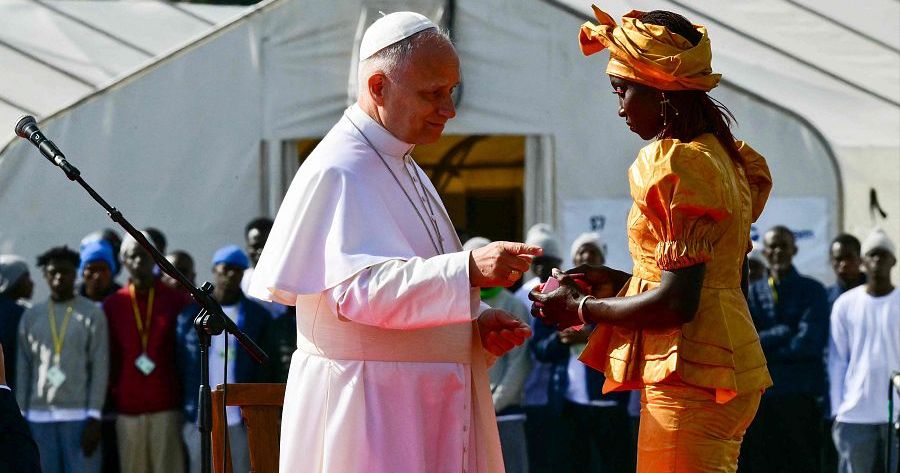
“Pope Leo XIV had a moving meeting with migrants and host organizations on June 11, 2026 at the port of Arguineguín. The dock, tragically known in previous years as the 'dock of shame' due to the crowding of people, was symbolically renamed that day the 'dock of hope'.”
Forcibly displaced persons are at high risk of becoming victims of trafficking. Forced to leave their familiar environment, they lose the support of their community networks and find themselves socially and culturally isolated. Moreover, faced with the difficulty of migrating legally, many of them have no choice but to take irregular routes, where traffickers operate.
Poverty, migrant status, insecurity and gender inequality are vulnerabilities that traffickers exploit.
Climate change exacerbates these vulnerabilities, acting as a destabilizing force that intensifies threats to human security and causes population displacement. At the same time, it increases competition for finite resources such as land and water or rare metals, fuelling conflict.
Sudden disasters, such as extreme floods or prolonged forest fires, are becoming more frequent and cause massive population displacements within the same region. The United Nations Environment Programme has found that, during environmental disasters, cases of human trafficking can increase by 20-30%.
In the words of UN Secretary-General Antonino Guterres, climate change is increasing the “desperation that allows human trafficking to thrive.”
LS No. 25: “The increase in the number of migrants fleeing misery, increased by environmental degradation, is tragic; these migrants are not recognized as refugees by international conventions and they carry the weight of their lives adrift, without any legal protection.”
Given these elements, in addition to the provision of services to IDPs, specific measures need to be taken to address vulnerabilities created by the effects of climate change. For example, farmers in the Sahel region of West Africa are at risk of losing all or part of their income due to desertification.
In order to prevent further population displacements, training programmes should be put in place to enable them to access jobs in productive and environmentally friendly sectors, with programmes promoting eco-responsible practices, such as planting and maintaining indigenous trees in specific habitats.
Only by recognizing that human trafficking can never be completely eliminated through a law enforcement-only approach, but also through a human rights-based approach, can progress be made on this issue. It must also be recognized that migration policies of exclusion and prohibition exacerbate vulnerabilities to trafficking and drive people into the hands of those who seek to exploit them.
Pope Leo XIV's recent visit to the Canary Islands in Spain was a strong sign of solidarity with migrants who risk their lives, as well as those who offer them shelter.
We conclude with the words of Leo XIV to Blessings, a migrant victim of human trafficking and whose testimony was read to the Pope by another woman on June 11 at the dock of Arguineguín, in Gran Canaria.
“Dear Blessing, even though you're not here today, your voice still resonates. Thank you for sharing your story.
Your name means‘ blessing ’, and it reminds us that every human life is a divine grace. No one can buy it, sell it, use it or throw it away, because in each person shines the image and likeness of the Creator. You told us that you left your country not by choice, but by necessity. In your words, we perceive the tragedy of so many people forced into exile, because poverty, war, threats or exploitation have blocked all their paths.
I hope this message reaches you and so many other trafficked and exploited women: if others have reduced your body to an object, God has never ceased to consider you priceless. If they have tried to lock you into a painful past, God continues to promise you a future. If you have been treated as an object, the Church wants to tell you today: you are a daughter and a sister, you are a blessing.”
May we also be a source of blessing in welcoming everyone.
International Commission on Integral Ecology
7/1/2026